
One of my favorite shots in Kyiv, Ukraine.. The Persheka Lavra shown through blossoms on an tree.. Sorry, I never did identify the tree.. probably should have but it was more the image of spring I was going for 🙂
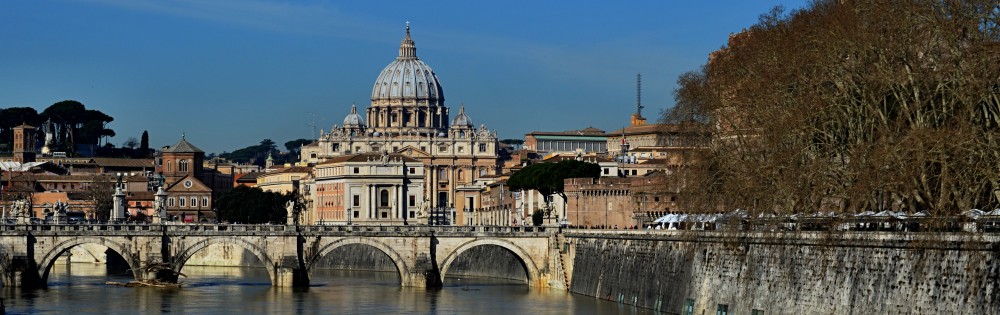
One of my favorite shots in Kyiv, Ukraine.. The Persheka Lavra shown through blossoms on an tree.. Sorry, I never did identify the tree.. probably should have but it was more the image of spring I was going for 🙂
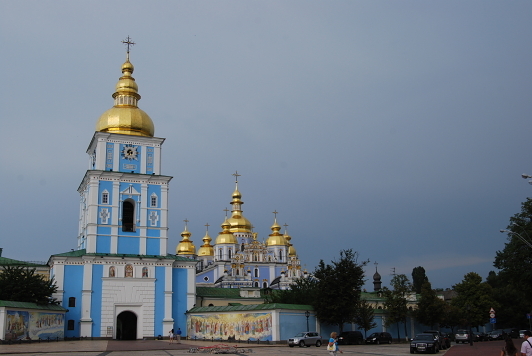
From Sofiyska Square, you will see another cathedral to the east.. St. Michael’s Golden Domed Monastery which sits on Mykhailivska Square.
 The original cathedral was built in the middle ages and dedicated to the Archangel Michael. It was demolished in the 1930’s after falling into disrepair but was reconstructed and reopened after Ukrainian independence in the late 90’s. While it is not an exact reconstruction of the original, St. Michaels is a beautiful sight to see.
Also on the square, is a monument to Olga of Kiev. Her husband, Igor of Kiev, was killed and she ruled as regent for her son Svyatoslav. If you read into the history of her rule, you will see she was ruthless in her protection of Kiev.
As we continue our way down Volodymyr Street back toward the city center, the next stop on our morning walk is at the next intersection – Yaroslaviv Val (Yaroslav’s Moat) Street. This is where you will find the sole remaining entrance to the ancient walled fortress-city of ancient Kyiv. Zoloti Vorota (Ukr : Золоті Ворота) literally means Golden Gates and it was one of 3 entrances into the city and the only one made of stone. Which probably explains why it was the only one to survive.

Zoloti Vorota – Golden Gate
The gate was constructed between 1017 – 1024 by Kyiv’s ruler, Yaroslav the Wise. There is a monument to him in Golden Gate Square beside the ticket office to the museum. He is seen holding St. Sophia’s Cathedral in his hands.

Yaroslav the Wise
Inside the museum, you can see a short film that details the history of the gate and the effort to protect and preserve the remaing structure. You can see the actual walls that were unearthed in the 1832. It wasn’t until the 1982, however, that the gate was reconstructed into its present form. The museum and square were dedicated during the 1500 year anniversary of the founding of Kyiv. The museum is open for visitors from 10:00 AM until 6 PM Thursday – Sunday and Tuesday, 10AM – 5PM on Wednesday, and closed on Monday. The cash desk and admissions close 30 minutes before the museum does. Admission is 15 UAH (approx $2.00 USD) for adults and 8 UAH for students and seniors.
The metro station that serves the area is also called Zoloti Vorota and is one of the prettiest in the city. Make sure you take a look!

Zoloti Vorota from the Square

This gallery contains 8 photos.
Just thought I would post some pictures from around Kiev.. Nothing really touristy here, just everyday type things I notice… You can find more here in my online galleries.. Photography as Art . I will be back with the continuing tour of … Continue reading
As we make our way back down Volodymyrska Street and across Shevchenko Boulevard, you will see several more buildings associated with the university. The National Academy of Science and the Ministry of Education are both on this street. But our next destination is a little farther and at the next corner. At the next intersection, on the northeast corner is the National Opera of Ukraine .

Ukrainian National Opera House – Front
Originally it was called the Kiev City Theater but was re-named after a fire destroyed the original building in 1896. The new building, opened in 1901, is a wonderful example of Neo-Renaissance architecture and has one of the largest stages in Europe. If you enjoy either, opera or ballet, I would recommend it. I have seen several productions and all were very well done. You can buy tickets and see schedules at the National Opera – Home.

Opera House and Tetralna Square
Adjacent to the National Opera House is Tetralna Square where a statue and monument to Mykola Lysenko (Ukrainian: Мико́ла Віта́лійович Ли́сенко) stands. Lysenko is the author of the classic Ukrainian operas – Natalka-Poltavka, Eneida and Taras Bulba.

Mikola Lysenko
Taras Shevchenko (Тарас Шевченко) was a Ukrainian writer and artist. His most famous literary work is a collection of poems entitled ” Kobzar “. His works are considered to be the foundation of modern Ukrainian literature and, in a large part, the modern Ukrainian language. Wikipedia has a wonderful and detailed look at his life and history. I highly recommend it as a brief introduction to the life of this famous Ukrainian writer / artist.
http://en.wikipedia.org/wiki/Taras_Shevchenko
I wanted to tell you about Shevchenko because we are going to take a stroll up the street that bears his name – Taras Shevchenko Boulevard.
It seems a little strange to me that Shevchenko Blvd begins with the city’s largest monument to Vladimir Lenin.

Monument to Lenin
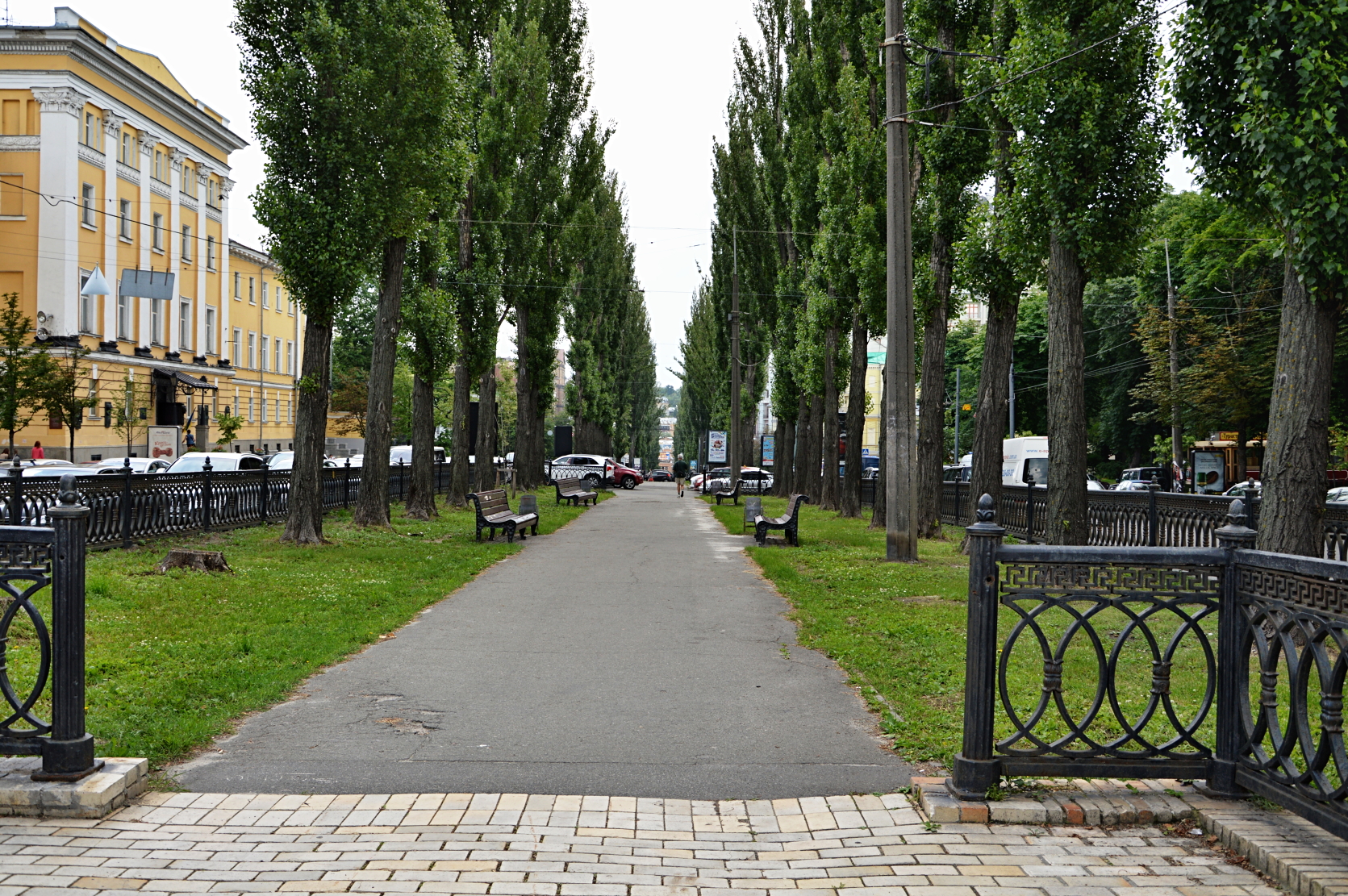
Shevchenko Blvd Pedestrian Path
This is a wide street with a sidewalk in the center. It is lined with trees and has plenty of benches to sit and people-watch or just relax and enjoy the weather.
After a very enjoyable 10 minute walk, you will find yourself at the intersection of Volodymyrska Street and on the corner of Taras Shevchenko Park. In this park you can see the most prominent statue of Shevchenko where it stands facing the huge red building that also bears his name – Taras Shevchenko University.

Monument to Taras Shevchenko
As you can see, when I said red, I mean red. The walls , columns, and facades are a rich earthy red in color. It is easily, one of the most recognizable buildings found anywhere in Ukraine. Although the ” Red Building ” is the main building of the university, there are actually 15 academic departments and 5 institutes spread throughout the city. The university also includes an astronomical observatory and the

Red Building – Taras Shevchenko University
A.V. Fomin Botanical Garden located behind the main building adjacent to the Universitet metro station.

A whole new world – That’s what you are thinking when you step out on to Kreshchatyk (Крещатик) Street. It doesn’t matter if you came by bus, metro or taxi.. you are immersed in a world that is probably vastly different than what you are used to … and you are right. It is a whole new world. But it is also strangely familiar.
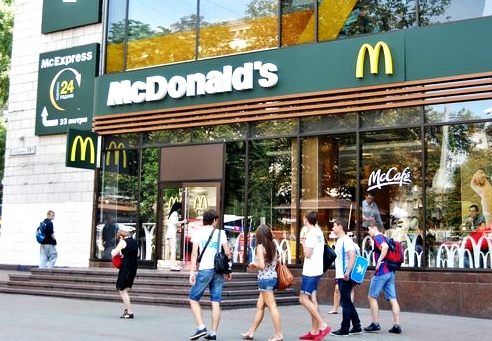
The street and plaza in front of Kreshchatyk metro station’s doors are full of people.. There are vendors selling their wares, people handing out flyers for almost everything imaginable.. people waiting to put a dove on your shoulders and snap a picture (which they will immediately try and sell you)… There are street musicians playing anything from guitars to bagpipes…. There are human statues.. There are people eating, drinking, laughing, dancing, or just going about their lives. It can seem a bit overwhelming but you’ll be fine. So grab your camera and let’s take a walk.
Even though it is only 1.2 km long, Kreshchatyk, is the main street in Kiev. It begins at European Square on the northeast and ends at Besserabtka Square. Nestled in-between is Independence Square, commonly called the Maidan.

European Square
European Square is home to the Ukrainian House and the National Philharmonic. You will also find the entrance to the Ukrainian/Russian Friendship Arch here.
As you head southwest along the street, you will notice that the buildings are all very similar in appearance. During WWII, the Red Army planted 100’s and 100’s of explosives in the buildings on both sides of the street. After withdrawing from the city, these explosives were detonated and virtually destroyed every building along the street. It was the first time that explosives were detonated using radio waves. After the re-occupation the buildings were rebuilt in the Stalinist style.
Maidan Nezalezhnosti, literally Independence Square, is the next stop along Kreshchatyk Street. This is the central square in Kiev and, most commonly called “the Maidan” .
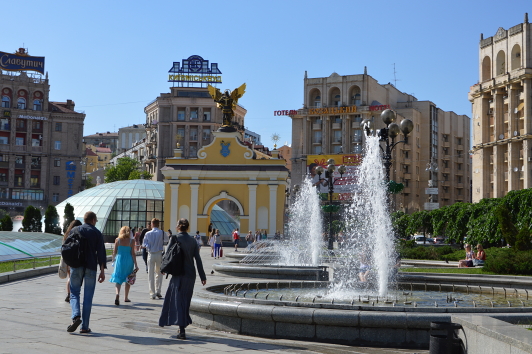
A monument to the Archangel Michael (spiritual protector of Kiev) can be seen among the fountains on one side of the street.

 The large glass domes are skylights to the underground mall Globus. The Cossak Mamy , the goddess Berehynia and Kyi, Schek, Khory and their sister Lybid, the legendary founders of ancient Kiev are on the other.
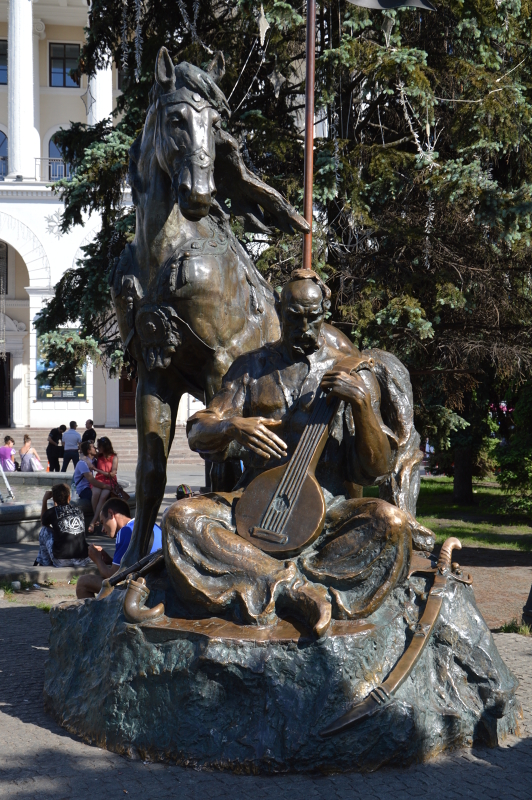
 The plaza here is also used for outdoor concerts, political gatherings and protests , and one of the largest New Year’s Eve parties I have ever attended.
Kreshchatyk Street is also blocked to traffic starting here, every weekend. I have been told several stories as to why this is done but my favorite is this:
During WWII Kreshchatyk Street is where the women waited for and met their families when they returned from the “front lines”. It was a place to be reunited with loved ones coming home from war. I do not know if that is a true story but this section of the street is always filled with families and couples.
Kreshchatyk Street continues southwest past the main post office and the administrative buildings for the city, the city council building and the central department store until you arrive at Besserabska Square.
Besserabska Square is the home of the Besserabska Rinok. It is a large enclosed market where you can find fresh fruit, vegetables, meat, dried fish and even caviar. It is where farmers from outlying villages came to sell their produce. Kiev’s main monument to Vladimir Lenin is located across the street at the beginning of Taras Shevchenko Boulevard.
Monument to Lenin
Besserabska Square is also where you can find the entrances to the underground shopping center – Metrograd.
And the journey continues ….
Personal Blog
Backpacker, solo traveller....you are in a right place!!
Блог о жизни и экскурсиях в Доломитовых Альпах
Documenting life as how I see it
“It takes a lot of imagination to be a good photographer."
and wake me when we're in love
Life in Japan.
Home of Lukas Kondraciuk Photography
Trip tips to get you where you didn't even know you wanted to be
Viajando por el mundo
"Not all those who wander are Lost"
of books and art
what if poems could be symphonies, and people their orchestra?


 Aren't We All Just Tourists Here?